

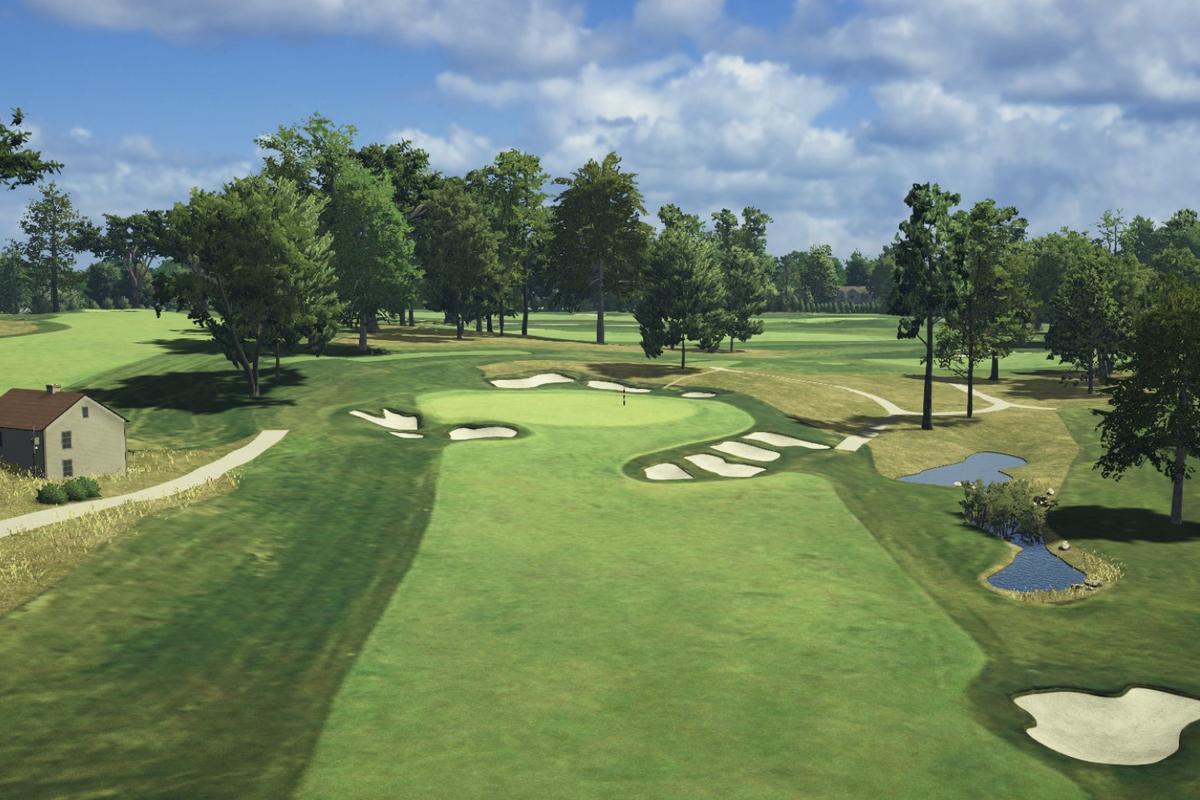
Donald Ross built Aronimink’s greens to punish overconfidence. Crowned, firm, and positioned to shed every shot that arrives a degree too flat or a yard short of perfect, they have been humbling golfers in Newtown Square, Pennsylvania since 1928. Walk off the wrong side of one of those greens and you’re not chipping uphill—you’re playing a 30-foot pitch from a downhill lie with no backstop, back toward a pin that has no interest in helping you.
Aronimink Golf Club is available right now on SKYTRAK through ForeSight’s core membership, and if you haven’t loaded it up yet, you’re leaving one of the best practice opportunities in simulator golf sitting on the table. The PGA Championship—one of golf’s four major championships, run by the PGA of America—is being played at Aronimink this week. The best players in the world are spending their days right now on these same crowned greens, these same tight tree-lined corridors, these same demanding par-4s that make up six of the first seven holes.
You can play the course while the tournament is live. You can walk every fairway, map every green complex, and collect real data on every shot while the broadcast is showing you exactly how the best players in the world are handling the same problems. That is not a minor footnote. That is a real-time feedback loop between your sim data and the highest-level golf being played on the planet this week.
The PGA Championship hasn’t been held at Aronimink since 1962, when Gary Player won the Wanamaker Trophy on this course. Sixty-four years later, the major is back. So is the course, in your simulator, available through the ForeSight core membership today.
This is a scouting report for simulator golfers. Treat it like the architect’s blueprints before the heist. You don’t just watch Aronimink. You play it first—and then you watch it differently.
Why Aronimink Stands Out in Your Software Library
Par 70. Not 71. Not 72. Seventy.
Aronimink plays just two par-5s—and both are reachable by the modern game’s longest hitters with a well-struck tee shot. There are two par-3s. The remaining fourteen holes are par-4s, and they are not the gentle, short variety. They average over 420 yards, and several require a full-blooded long iron into a crowned green with penalty lurking on all sides.
What this means in practice: there are no free rides on this course. On a par-72, a golfer can play the par-5s aggressively, protect on the par-3s, and hold on through the hard par-4s. At Aronimink, every hole demands something. The par-5s must be attacked because you need the birdies—the course won’t give you enough elsewhere to coast to a respectable score. The par-3s play over 200 yards when the pins are tucked. The par-4s will take strokes from you whether you’re ready for them or not.
When Justin Rose won the 2010 AT&T National at Aronimink, the course yielded less scoring than it does at virtually any other regular tour stop the field visits. That was a standard PGA Tour event. A major championship setup—tighter rough, faster greens, pins on the edges of Ross’s sloping surfaces—is another level entirely.
The Course in Three Acts
Ross built Aronimink in 1928 on rolling terrain outside Philadelphia, and the routing takes full advantage of the natural grade changes. Fairways tilt and heave. Greens sit above approach angles in some spots and below them in others. The course plays more than 7,200 yards from the championship tees—manageable on paper, demanding in practice, and genuinely punishing once the PGA of America’s setup crew has had their way with the rough and the green speeds.
Aronimink breaks cleanly into three acts. Understanding the structure will change how you manage your sim session from the first drive.
Act I: Holes 1–7 — Survive Without Accumulating
The opening seven holes at Aronimink are among the most relentless stretches in major championship golf. You play six par-4s in the first seven holes—the lone par-3 (hole 3) offers no relief since it plays over 205 yards to a small, crowned green. The first par-5 doesn’t show up until hole 8.
The world’s best players average barely under par through this stretch even in regular tour conditions. In a major, with the rough grown in and the greens running fast, the scoring average through the opening seven climbs. This is a hold-your-score section. The players who make it through even par or better are typically in strong position come Sunday.
The temptation on a simulator is to grip it and go, especially when you’re not grinding for a paycheck. Resist that impulse completely on these first seven holes. What you’re looking for is dispersion data. After your first two sim rounds through the opening stretch, pull your driver dispersion numbers and look at the shape of your misses. Aronimink’s fairways narrow through the landing zones. A miss of 20 yards right at Hole 1 finds rough; a miss of 30 yards finds trees. Your session data will show you, with mathematical precision, what percentage of your drives would hold the short grass.
That’s the real score here. Not the number on the virtual card—the data you’re collecting for your actual game.
Goal for Act I: Play the opening seven holes five times and track your GIR rate. Elite players hit around 70 percent of these greens in regulation. A 15-handicap who can hold 40 percent GIR through this stretch is managing Aronimink correctly. If you’re below 25 percent, your approach data will tell you why—whether it’s carry distance coming up short, dispersion pushing you long and right, or landing angle running you through the back.
Act II: Holes 8–13 — Score. Earn It.
The middle section of Aronimink is where the scorecard can shift, but “scoreable” here means something different than it does at most courses. There are no easy holes. There is a par-5 at hole 8 that a well-struck driver plus fairway wood can reach in two, and a second par-5 at hole 12 that rewards a precise layup over a forced carry. These are the two birdie magnets on the course. In a major championship, professionals typically play them a combined two-to-three under par per round—and still consider that good work.
The par-4s in the middle section are shorter—holes 9 and 11 are both under 410 yards—but the green complexes don’t get easier just because the yardage drops. A wedge hit from 125 yards to a crowned Donald Ross green still needs the right landing angle and enough spin to hold. A shot that comes in too shallow at 6,000 rpm is going to bounce off the front of that putting surface and leave you a chip from a very difficult angle.
Use this section to work on your wedge spin data specifically. Find your spin rate from full wedge swings at 100, 115, and 130 yards. Write those numbers down. Then use them to map your optimal layup distances on holes 8 and 12. If your gap wedge delivers 9,400 rpm from 110 yards, that’s the number you want to leave yourself on the par-5 layups. Not 95. Not 120. The number that produces your best spin and your tightest landing dispersion.
Goal for Act II: Track your approach proximity on holes 8–13. Average proximity to the hole from inside 150 yards tells you more about your iron game than any other single metric. The best players in the world average around 22 feet. A good simulator practice goal for a 10-15 handicap is under 40 feet. If you’re averaging 55+ feet, your carry precision needs work before Aronomink takes full advantage of the misses.
Act III: Holes 14–18 — Execute Under a Microscope
If Quail Hollow has the Green Mile, Aronimink has its own merciless closing act. The final five holes demand something specific from every shot—and the demand changes from hole to hole, which is what makes the finish so brutal in a major championship. More than one Wanamaker Trophy has been won and lost on this stretch.
Hole 14 (par-4, ~450 yards): A long, straight par-4 that requires a driver you can trust and a mid-iron approach to a green that slopes severely from back to front. The back pin position is the most punishing on the course—and in a major, that’s exactly where they’ll put it on Sunday. On your sim, check your mid-iron carry distances from 175–195 yards. If your 6-iron carries 185 but you’re uncertain about your 5-iron, this hole will expose that gap. Know your numbers before you’re standing over them.
Hole 15 (par-4, ~420 yards): A dogleg right that rewards a slight fade off the tee. If you play a natural draw, you’ll run through the fairway into the rough on the right and leave yourself a blind approach. Pull your face-to-path data on the tee shot here. You’re looking for a path that’s 2–3 degrees inside-to-out with the face slightly open—a controlled fade, not a slice. Practice it in the sim until the shape is repeatable.
Hole 16 (par-3, ~215 yards): One of the most demanding par-3s in major championship golf. Mid-iron over a bunker complex to a green that is, of course, crowned—running off in four directions. The key data point: landing angle. A shot that comes in at 25 degrees won’t hold the surface. You need 32 degrees or higher to stop within 15 feet of a center pin. If your 5-iron typically launches at 17 degrees and the hole is playing to 215, you may need a softer 4-iron to get the height.
Hole 17 (par-4, ~430 yards): The drive plays uphill to a blind fairway. Aim for the left side of the landing area—the fairway rolls right, and anything center-to-right finds a downslope that kicks into the rough. Check your dispersion data after five tee shots here. How many would have held the left half of the fairway? That number is your score on this hole before you ever hit an approach.
Hole 18 (par-4, ~455 yards): The closing hole is quiet brutality—long, straight, and demanding in a way that doesn’t announce itself loudly. The fairway is generous. The green isn’t. The approach plays uphill to one of the most severely crowned greens on the course. When a major champion wins here on Sunday, they will have navigated this green three or four times under maximum pressure. Attack angle data matters: coming in too shallow gives you a lower trajectory that won’t hold the back-to-front slope. Find your ideal iron attack angle data and practice finding it under pressure.
Your Sim Scouting Report: Data Targets by Section
These are realistic benchmarks for a 10-to-15-handicap simulator golfer playing Aronimink. They’re not major championship targets—they’re the numbers that indicate you’re managing the course strategically rather than just reacting to it.
Opening Stretch (1–7):
• Driver dispersion: under 45 yards total spread
• GIR rate: 35% minimum (5 of 14 greens across two rounds)
• Penalty-shot rate: fewer than 1 per 7 holes
Middle Section (8–13):
• Wedge spin rate (full swing, 95–130 yards): 8,500+ rpm
• Carry precision on par-5 layups: within 8 yards of target
• Approach proximity from under 150 yards: under 40 feet average
Closing Act (14–18):
• Mid-iron carry: know your 5-iron and 6-iron to within 3 yards
• Landing angle on hole 16 par-3: 30+ degrees
• Face-to-path on hole 15 tee shot: practice a controlled fade (path 2–3 degrees in-to-out, face slightly open)
• Hole 18 iron attack angle: between -3 and -5 degrees (check against your ForeSight club data)
What to Watch During the PGA Championship Broadcast
The PGA Championship is live this week. You can load up Aronimink on your sim in the morning, play a round, and watch the same course on television in the afternoon. That real-time loop—your data in the morning, the world’s best players in the afternoon—is the most powerful practice tool you have available right now.
Watch scoring distribution by act. The broadcast will show hole-by-hole scoring averages throughout the week. Compare those averages to your sim rounds. Where the pros accumulate strokes in a major, you accumulated strokes—probably more. But the shape of the difficulty should look similar. If hole 16 is playing as the hardest hole on the course for the field and it was also your worst hole, that’s not coincidence. That’s Ross (and Gil Hanse and Jim Wagner, through their sympathetic renovation in 2018) doing exactly what he intended, at every level of the game.
Watch tee shots on holes 15 and 17. These are the two holes where shot shape is the primary variable. Players in contention at a major pick a shape and commit completely—you’ll see it in the broadcast data overlays. Note who hits draws on 15 and compare their approach positions to the players who leak a fade into the rough. The numbers will confirm what you felt in the sim.
Watch approach data on the par-3s. The broadcast will show launch angle and carry distance on the par-3 shots. When a player stuffs the 16th to three feet, look at their launch angle in the data overlay. It will almost certainly be north of 30 degrees. File that against your own numbers. The gap between you and a major champion on that shot is partly equipment, partly swing, and partly—more than most people realize—the deliberate management of a specific number.
Watch layup decisions on the par-5s. Pay attention to where the caddies send their players on holes 8 and 12. Full-wedge distance. Not a half-swing number. The specific yardage that matches peak spin and control. This is the principle you practiced on your sim—now watch it applied at a major championship with the Wanamaker Trophy on the line.
The Bottom Line
The PGA Championship returns to Aronimink for the first time since Gary Player lifted the Wanamaker Trophy here in 1962. The course hasn’t changed its character in those 64 years. It is still par 70. It still has 14 par-4s. The greens are still crowned. The rough is still punishing. Donald Ross built something that was already asking hard questions of golfers in the 1920s, and it hasn’t stopped.
SKYTRAK's ForeSight core membership put this course in your simulator library this week, while the best players in the world are competing on it live. That timing is not an accident. Play it this morning. Watch the broadcast this afternoon. Compare your data to what you see on television. Then play it again tomorrow.
That’s not just simulator entertainment. That’s the most engaged you can be with a major championship as a golfer—not just watching it, but understanding it from the inside.
Frequently Asked Questions
What makes Aronimink Golf Club unusual compared to other major championship venues?
Aronimink is a par-70, which is rare among major championship venues. The course plays only two par-5s and two par-3s across eighteen holes, meaning fourteen holes are par-4s averaging over 420 yards. This eliminates the scoring cushion that par-5s typically provide at other majors. At Augusta National, players can count on four chances to go under par on the par-5s alone. At Aronomink, every stroke under par must be manufactured through precise iron play and putting. Combined with Donald Ross’s crowned, firm greens, the course demands a level of approach precision that exposes even elite ball-strikers.
How does Donald Ross’s design affect how you should play Aronomink on a simulator?
Donald Ross crowned his greens—built them slightly higher in the center than on the edges—so that shots arriving without enough height and spin roll off the sides and leave awkward pitches back. On a simulator, this means approach shots that register as “on the green” in the visual display may still leave poor positions if your landing angle was too shallow. Use your landing angle data as your primary feedback mechanism. Anything consistently below 28 degrees on par-3 tee shots or long-iron approaches signals a real problem that would surface immediately on Ross greens regardless of the scorecard result.
Has the PGA Championship been held at Aronimink before?
Yes. The 1962 PGA Championship was played at Aronimink Golf Club, and Gary Player won it—one of nine major championships in his career. That was the last time the Wanamaker Trophy was awarded at this course. The PGA of America’s decision to return after more than six decades reflects both the course’s quality and its capacity to provide a genuine test at the highest level of the game. The 1962 field included Arnold Palmer, Jack Nicklaus (in his first year as a professional), and Sam Snead—and the course held up against all of them.



コメントを書く
全てのコメントは、掲載前にモデレートされます
このサイトはhCaptchaによって保護されており、hCaptchaプライバシーポリシーおよび利用規約が適用されます。